THE COINCRAFTERS PROCESS
How It's Made
From start to finish, each authentic coin is forged by hand and expertly crafted into a beautiful piece of jewelry. Through careful shaping, folding, and finishing, we preserve the character and history of the original coin while transforming it into a one-of-a-kind ring made to be worn for generations.
A few of the questions I get asked most are, “How are the rings made?”, “Does it require special tools?”, and “How much would it cost to make my own coin rings?” So I decided to put together this little journey through how a coin ring is actually made.
The answer to the second question is yes—there are some special tools required, as is usually the case with any trade. The answer to the third question is a little more complicated because it depends on your end goal. If you are only looking to make yourself one coin ring to wear, it is going to cost considerably more than simply buying the finished ring.
Making rings from coins is an art form, and it takes quite a bit of time and practice to reach the skill level needed to produce a high-quality ring—so don’t expect your first ring to look amazing. Tools also vary considerably in quality and price. Better tools can make the job easier, but they come with a higher upfront cost. Specialized coin-ring tools are definitely not cheap, but that is what it takes to make the best-quality rings. We’ll get into some of those differences below.
Coin Ring Crafting
Annealing & Quenching
Working silver, gold, copper, and similar metals require you to anneal the metal. Annealing is simply heating the coin to a dull red glow which makes the metal more malleable and easier to work with. Through-out the crafting process of pressing and stretching, the coin will work harden and need to be annealed a few times.
Punching The Hole
Before you can begin folding the coin into a ring, you first have to make the initial center hole. The quickest way to do this is with a punch set. Cheaper punch sets for general use can be had for around $25 at online stores such as Harbor Freight. The better punch kits specifically made for coin rings run quite a bit more, around $200, but come with different size punches and special rings that self-center any U.S. coin to make a perfectly centered punch. Punch sets like the one shown can be found at www.JasonsWorks.com.
Stretching & Folding
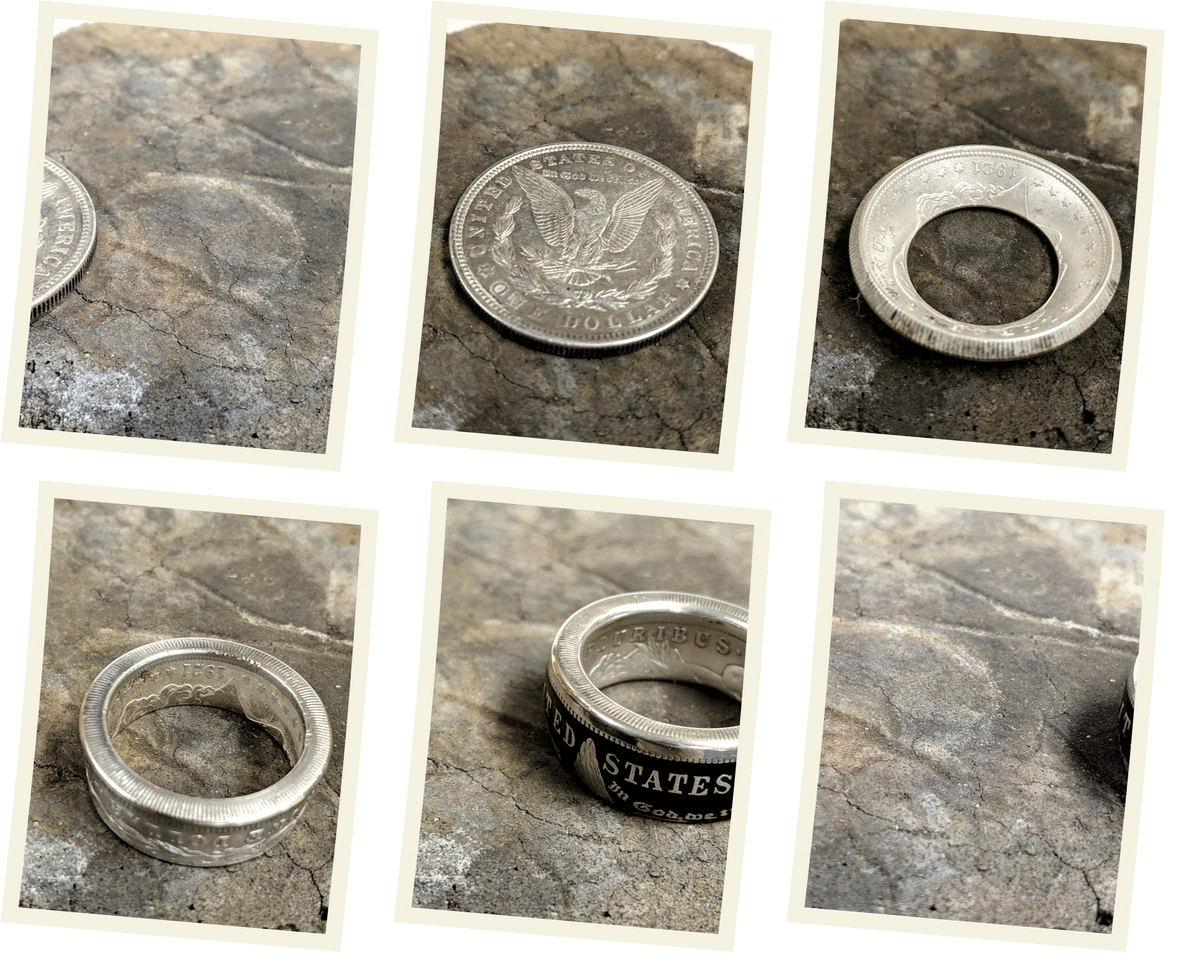
Once the initial hole is punched it's time to start the folding process. Folding is done by using cones and delrin ball bearings placed inside the center hole and pressed into coin ring dies using a ring stretcher/ reducer or arbor press. Here, after a series of cones, the coin will take on a cone shape itself. It is then put on the stretcher and given a few pulls to straighten up the walls a bit and help remove some of the cone shape. The next step is to flip the coin rim-side down in the die and it's given a good press to remove the rest of the cone shape. At this point the coin will resemble a ring.
The next step is to flip the coin rim-side down in the die and it's given a good press to remove the rest of the cone shape. At this point the coin will resemble a ring.
Sanding & Polishing
The last step of how coin rings are made is to fine tune, sand, and polish the coin ring. The edges are removed and rounded with a rotary tool and fine sanding drum to provide more of a comfort fit.From there it is given a high polish shine using buffing wheels and silver polish or, if preferred, given an antique finish using liver of sulfur or special antiquing solutions. The final result is a stunning ring made from an authentic coin and sure to grab the attention of anyone in the room.
To order one of the beautiful coin rings shown above please click the following link:
THE FINISHED PIECE
Wear a Piece of History
Every CoinCrafters ring begins with an authentic coin and is individually handcrafted using the same process shown above. Explore Morgan Silver Dollar rings, historic U.S. coin rings, and handcrafted coin jewelry.


